
Redundancy is Resilience: Emergency Preparedness for Lift Stations
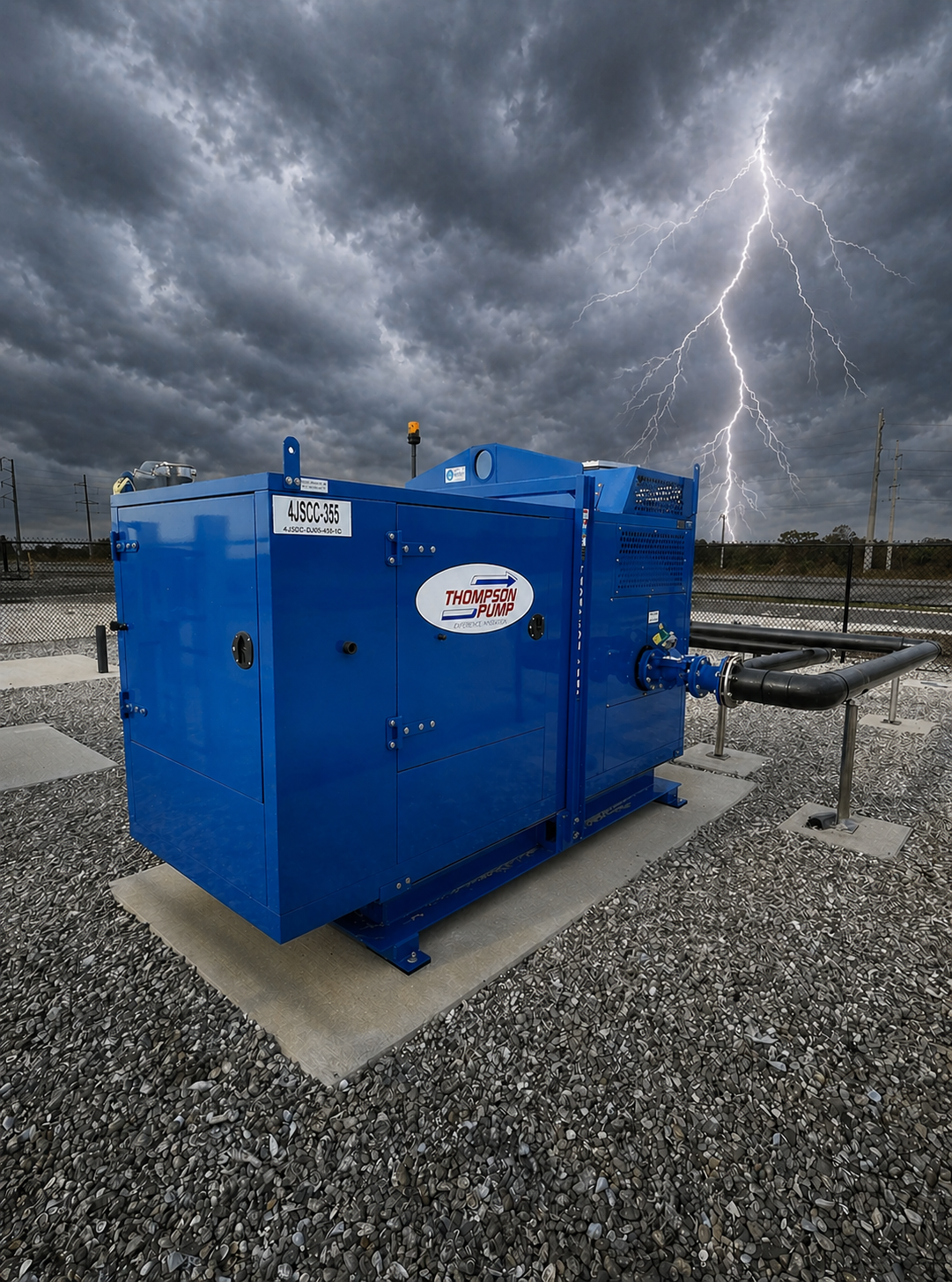
Emergency Preparedness for Lift Stations
By: David Perry, Municipal Sales Manager for Thompson Pump & Manufacturing Company
With hurricane season beginning on June 1, 2026, municipalities and consulting engineers are once again evaluating the best methods to prepare their infrastructure for emergency events. While early forecasts suggest a near-to below-normal season, elevated sea surface temperatures could generate a single storm with the potential to cause widespread damaging impacts throughout a wastewater collection system. Current projections estimate 13 named storms, including several major hurricanes that could directly impact the United States. These storms bring massive amounts of rainfall, storm surges, increased lightning activity, and most importantly, damaging winds that can sever the electric power supply to the existing grid.
For wastewater collection systems, the risk extends far beyond power outages. Flooding, equipment failures, damage to instruments and controls, and overwhelming inflow and infiltration (I&I) can quickly compromise lift station performance. When these systems fail, municipal utilities not only face operational disruptions but also regulatory fines/penalties, public health risks, and environmental damage.
The Critical Role of Lift Station Reliability
Lift stations are critical control points within wastewater collection systems—particularly in flat or low-lying areas where gravity conveyance is not feasible. Under normal conditions, electric-driven submersible pumps efficiently move wastewater to treatment facilities.
During severe weather, however, multiple failure points can occur simultaneously:
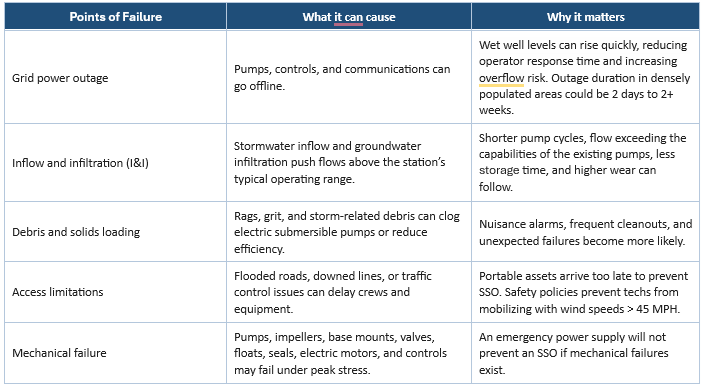
Because these risks often occur at the same time, emergency preparedness must address system-wide resilience rather than isolated vulnerabilities.
Defining True Redundancy
Resilience in lift stations is achieved through functional redundancy, the use of independent systems capable of maintaining operations when primary components fail.
This goes beyond simply adding backup power. Effective redundancy reduces system dependencies, anticipates realistic failure scenarios, and integrates both technical and operational safeguards to ensure continuity of service.
Redundancy as a Design Strategy with Diesel-Driven Systems
One of the most critical considerations in lift station design is maintaining pumping capability during a power loss or system disruption through an alternate energy source. Diesel engine-driven systems are widely used in emergency applications due to several key characteristics:
· Reliability: Emergency stand-by diesel engines are balanced, lower cost, require no after-treatment to comply with emergency stationary emission standards, and battle-tested through the years.
· Familiarity: Diesel engines have been frequently used in most heavy equipment for many years, and most technicians have a basic working knowledge of maintenance requirements. Fewer components reduce complexity and potential failure points.
· Availability: Multiple options for different diesel engine manufacturers with ESTAT labels.
· Support: Aftermarket support infrastructure for diesel engine components is diverse, with locations to support most domestic municipalities.
· Efficiency: Automatic start/stop control panels allow engines to operate intermittently, resulting in lower fuel consumption, less on-site fuel storage required, and a smaller footprint.
· Rapid response: Immediate startup without power transfer sequencing.
· Adaptability: Variable RPM control allows the engine to respond dynamically to the application.
These attributes make diesel-driven systems well-suited for maintaining performance during emergency conditions.
Limitations of Portable Emergency Response
Historically, many utilities have relied on portable pumps and generators to provide temporary backup during emergencies. While effective in planned scenarios, these approaches introduce logistical challenges during severe weather, including:
· Deployment delays due to limited resource availability
· Safety of staff during mobilization and set-up in hazardous conditions
· Increased fuel coordination and fuel consumption
· Additional portable accessories required and must be in good working order
· Additional staff required for set-up, greater potential for set-up or operational errors
In widespread events, these constraints can significantly reduce response effectiveness.
Stationary Bypass Pumps vs. Generator Systems
Generator backup systems rely on multiple interconnected components—including automatic transfer switches (ATS), electrical connections, and existing control panels. Each of these elements must function correctly during an emergency, increasing the risk of cascading failures. They also only address power loss. They do not mitigate risks associated with mechanical failure, debris loading, or system overload—factors that frequently contribute to sanitary sewer overflows (SSOs) during severe weather.
In contrast, stationary bypass pumps operate as self-contained units independent of the electrical system. This eliminates several common failure points and ensures that pumping capability is maintained regardless of grid conditions or electrical system performance.
This distinction between these two options becomes critical during severe weather events, when the likelihood of cascading failures increases. These characteristics make diesel engine-driven bypass pumps particularly well-suited for an emergency scenario.
A More Resilient Approach: Stationary Bypass Pumps
Stationary bypass pumping systems provide a more robust and reliable alternative by integrating full redundancy directly into lift station design. Permanently installed and ready for immediate operation, these systems eliminate many uncertainties associated with emergency response.
These systems are designed to:
· Operate automatically in response to rising water levels in the wet well
· Function independently of the electrical grid, so no ATS required
· Handle solids and debris commonly found in wastewater
· Run intermittently and unattended for extended periods during emergency events
· Less full consumption due to intermittent operation with less on-site fuel storage
· Handle a wide range of flow rates at various pressures with variable RPM control
· Communicate with SCADA systems or provide redundant wireless communication/control
By removing the need for manual mobilization, setup, and intervention, stationary bypass systems significantly reduce response time, improve reliability, and allow the collection system to function properly when it matters most.
Reducing Risk and Long-Term Costs
While portable systems remain useful for planned maintenance, permanent installations provide a higher level of preparedness for emergency events.
Stationary bypass systems reduce reliance on external resources and minimize labor demands during critical periods. Operators can focus on monitoring and system management rather than equipment deployment.
Over time, these operational advantages translate into financial benefits. Avoiding even a single overflow event can offset the initial investment by reducing emergency response costs, environmental remediation, and regulatory penalties.
Preparing for the Season Ahead
Emergency preparedness is not defined by how many storms occur, but by how systems perform when they do. As climate variability increases and infrastructure continues to age, the need for proactive resilience-focused planning becomes more urgent.
Utilities that prioritize functional redundancy, reduce system dependencies, and invest in permanent backup solutions are better positioned to protect public health, maintain regulatory compliance, and ensure continuity of service.
Resilience is not built in the moment of crisis—it is built well before it arrives.
For more than 20 years, David Perry has worked at Thompson Pump & Manufacturing Company in various positions. Perry was promoted to municipal sales manager in 2014 and oversees all government business activity for the U.S. and Canada. Perry teaches at Thompson Pump’s Pumpology® schools, conducts regional trainings, and has presented at several national conferences, including WWETT and FRWA. Perry holds a bachelor’s degree from the University of Florida and is also an active member of AWWA, APWA Central Florida Branch, FLAGFA-FL Association for Governmental Fleet Administrators, and various other organizations.
Be sure to check us out in Pumps & Systems!